The Roll of Battle Abbey
Earliest Record of the Normans
or
A Myth That 'Ought' to Have Existed?
by James S. Dorrill
John Bernard Burke, Esq., in his preface to a list of names appearing on a table once suspended in the Abbey memorial (The Roll of Battle Abbey, Annotated, Baltimore: Genealogical Publishing Co., reissued 1978), gives this account: "The roll of Battle Abbey, the earliest record of the Normans, has at all times been regarded with deep interest, by the principal families of the kingdom—by those who shew descent directly from the chiefs of the Conqueror's host, as well as by those who indirectly establish a similar lineage. |
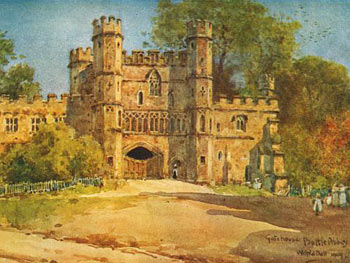 |
The Abbey of Battle, a memorial of one of the most important events in English history, was erected upon a plain called Heathfield, about seven miles distant from Hastings, in fulfillment of a vow made by the Conqueror prior to the battle which won for him the diadem of England. Within a year, the foundation was laid on the very spot where the battle of Hastings had been fought, and but a brief period subsequently passed, until the Monastery itself arose in all its magnificence, richly endowed and highly privileged, dedicated to the honour of the Holy Trinity and St. Martin, the high altar standing where Harold and the Saxon standard fell. The Conqueror at first designed that this great religious House should accommodate one hundred and forty monks, but provisions appears to have been made for sixty only. The first community, a society of Benedictines, came from Marmonstier, in Normandy, and were enjoined to pray for those who died in the battle, and to preserve a faithful record of all who shared in the glory of the victory. Thus arose the Abbey of Battle, and thus the Roll of Battle Abbey. The endowments of the royal founder upon the Abbey and the holy Brethren, were in the extreme liberal and munificent. Aldiston in Sussex, Lymsfield in Surrey, How in Essex, Craumere in in Oxon, and Briswalderton in Berks, together with a league of land around the house itself, were but a portion of their vast domains. They had beside the churches of Radings and Colunton, in Devon, and St. Olavc, in Exeter. The immunities they enjoyed were alike considerable. Their grand charter exempted the brethren of Battle from episcopal jurisdiction, treasure-trove, and free warren. The Abbot wore the Mitre, and was invested with a power to pardon any felon whom he might chance to meet with going to execution. From foundation to dissolution the Abbey of Battle had a succession of thirty-one mitred Abbots; the last, John Hammond, was chosen in 1529. The site of the dissolved abbey was granted by Henry VIII to Richard Gilmer, who sold the estate to Sir Anthony Browne, from whose descendants, the Brownes, Visconts Montaguae, the abbey and lands passed again by sale to Sir Thomas Webster, Bart., in whose family they are yet vested. The still extant ruins, computed at not less than a mile of ground, bear ample testimony to the splendour and magnificence of the celebrated monastery of Battle. The Table containing the following names was formerly suspended in the Abbey, with this inscription:— Dicitur a bellow, bellum licus hic, quia bello Burke then gives a list of a thousand or more names. Included on that list is an entry for Darell. Following the list, he goes on to give additional information on each surname. This is what it says on Darell: "DARELL—The descendants of this Norman Knight established themselves over various counties, and for centuries flourished in all: the principal were those of Calehill and Scotney, in Kent; of Sesay, in Yorkshire; of Littlecote, in Wiltshire; of Pageham, in Sussex; of Trewornan, in Cornwall; of Lillingston Dayrell, Bucks; and Shudy Camps, in Cambridgeshire. A curious trial is on record with reference to the Littlecote branch. Its chief was arraigned for murder of an infant child, on the evidence of the midwife, who detailed, with most circumstantial minuteness, her journey, blindfolded, to a residence which she supposed to be the ancient manor-house of Littlecote, her presence at the birth of a male child, and her belief, founded on many circumstances she narrated, that the infant was burnt to death. On cross-examination, however, her evidence broke down, and Dayrell was acquitted, but the train of calamity which succeeded the trial may give rise to melancholy reflections, and was no doubt considered by the multitude to have been the effect of Divine visitation. In a few words, the owner of Littlecote soon became involved in estate and deranged in mind, and is stated to have died a victim to despondency; and ruin and misery are said to have befallen the family that survived him." [A more detailed account of this episode is recounted in Book 1: Sir William Darell of Brodsworth, Yorkshire] In a book first published in the late 1890s by Mark Antony Lower (A Dictionary of Family Names of the United kingdom, New York: Heraldic Publishing Co., reissued 1967), Lower questions the validity of "...what is called the Roll of Battle Abbey." Lower goes on to say: "Very often...I have spoken with distrust and disparagement of what is called the Roll of Battle Abbey. In my English Surnames [another book by Lower], I printed three considerable lists of Norman surnames going under this general designation, not however without duly cautioning the reader against accepting them as genuine documents of the period to which they are ascribed. Fuller investigation convinces me that the Roll of Battel [sic] Abbey is a nonentity. But like many other mythic things, we may safely say that it OUGHT to have existed. For, the conqueror on the field of Hastings made a famous vow that if God would grant him the victory over the English, he would found upon the spot a great Abbey, wherein masses should be said for all those who should be slain in the battle. Now, when the Victor carried his intention into effect, there OUGHT to have been a bede-roll or list of those whose souls were thus to be cared for; (and this, as Mr. Hunter [another authority on the period] has well observed, would have been 'in the highest and best sense, the Battel Abbey Roll'), but if we consider the utter improbability of his having had a muster-roll of the vast army who embarked with him on this expedition, and at the same time reflect upon the impossibility of the monks performing the Church's rite individually for the souls of the thirty-thousand warriors who are said to have fallen on that dreadful day, we shall at once see that, however theoretically accordant with the vow such an arrangement may have been, it could not be practically carried out. It may be urged, however, that a Roll containing the names of the leaders and grandees of the expedition was preserved. But to this it may be replied that, although Battel Abbey was unusually rich in every kind of monastic chronicle, record, and other muniment, most of which are preserved to the present day, no mention whatever is found of such list or Roll, either during the existence of the Monastery or at its Dissolution. But while the existence of any such record as an authoritative roll of the Norman invaders is denied, there can be no doubt that the various lists which purport to be THE Roll of Battel Abbey are of considerable antiquity—much earlier probably than the date of the Reformation, though certainly much later than the year 1066. Mr. Hunter mentions no less than ten such lists, but in no case is there an attribution of them either to Battel Abbey or to an authority nearly contemporary with the Conquest. It is not necessary to accept the censure of others as to the falsifications of one or any of these lists by the monks of Battel in order to gratify the vanity of benefactors. They were doubtless drawn up, as a matter of curiosity, by private individuals, without any sinister design. Perhaps the greatest proof of their being non-official, and of a date long subsequent to the Conquest is, that many of the names of distinguished followers of William which are found in Domesday Book have no place in any copy of the so-called Battel Abbey Roll." |
|