The Origins and
Spelling Variations of our Surname
by James S. Dorrill
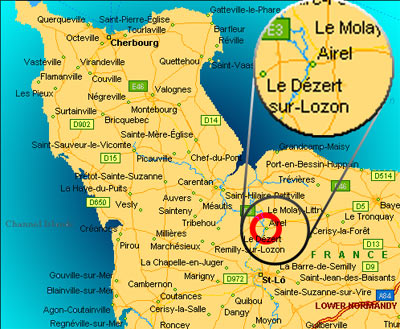
| Early on in my genealogical research, at sometime in the first half of 1979, a newspaper feature called "Know Your Name" by J. C. Downing began to appear in my local daily newspaper. An editor's note said Downing will trace the derivation of names sent in by the readers. So, a few weeks after the nationally syndicated feature began to run, I submitted the surname of "DORRILL". In March 1980, the response appeared: ~~~~~~~~~~~~ DorrillThe English surnames Dar(r)ell, Dayral, Dayrell, Dorrell and Dorrill were acquired from once having lived in Airelle, a place in Normandy, France, or at places or similar spelling. In England, Thomas de (of) Arel was noted in Yorkshire in 1166, and Marmaduke Darel was noted there in 1381. Ralph Darel(l), or Dairel(l), was noted on the Isle of Manx in 1204. Henry de Ayrel, or Dayrel, was noted in Berkshire in 1235. Gilbert Darele was noted in Lincolnshire in 1273. Henry Darell and Mary Legg were married in Canterbury in 1663. Burke's General Armory describes the Darrell, the Darel or Dorrell, the Dayrell, the Dayrolles and the Dorrell arms. In Virginia, Joseph Deryell was a headright in a 1655 Northampton County land grant. Thomas Darrell held land in the same county prior to 1657. Edward Dorrell was granted 203 acres in New Kent County in 1679. The 1790 census lists the spellings Dar(r)el(l) in New York, South Carolina and Virginia, Dorrel(l) in Connecticut and Maryland, Derril(l) in Maine, Massachusetts and South Carolina, and Dorrill in South Carolina. ~~~~~~~~~~~~ During research, you will run across three major spellings of the surname: Dorrill - Dorrell - Darrell As you can see, the difference is the vowel (a, e, i, o) that precedes either or both sets of the double letters. (By the way, the definition of a vowel is "...in English articulation a speech sound produced without occluding, diverting, or obstructing the flow of air from the lungs; as opposed to a consonant.) Along with this, you will also see the surname without one of the double letters. This leads to a myriad of combinations. With just one of either double letters omitted, it is still recognizable, but omitting one each of the double letters makes a big change, mostly in the length: i.e., Darel. And then you may see it (as in "Know Your Name") where the semblance to the surname is simply that it begins with a "D" and ends with an "L": i.e., Dayral, Dairel, Deryell. There are some (still referring to "Know Your Name") that are so far from the common spellings that the name might just as well be Smith or Jones: i.e., Darele and Dayrolles. And what is more confusing is that occasionally you may see a document (or transcript) where the name is spelled several different ways within the same document, or series of documents, and referring to the same individual. In a series of letters to and from Lord Ashley (later Shaftsbury) of England in 1669-71, concerning John Dorrell of Bermuda, John (the same individual) is referred to variously as: Dorrell, Dorrill, Dorrel, Dorral, Dorel, Darrell, Darrel. Edward Henry Dorrell of Hereford, England, in his booklet "A Dorrell Family History" (1985), writes: "The name is almost certainly of Norman origin. Many different spellings of it are to be found through the centuries before it reached its present form, including Dairel, Dayrel, Dayrell, Doreil, Doreill, Darel, Darell, Dorreill, Doril, Dorol, Durel, Durell, D'Orell, Dorel, Durrell, Dorriel, Darwell, Dorwell, Dorill, Dorril, Darrell, Darral, Dorrall, Dorell, Dorrill, Darol, Dorral, Darral, Dorrol, Dorrel. Other possible diminutives: Old German Darila (9th century); English Darley, Durley; French Dareau. Although there are so many different variants of the name, the spelling had little or no significance and it is probable that any bearer of it had an ancestor who came from Airel, a small village in Normandy, between St. Lo and Carentan." When William The Conqueror established himself in England, surnames were almost unknown, even among noble, baronial families. They were not generally adopted until the 13th century (1200s) or later, although there are traces of them much before that. Most English surnames are derived from names of places or occupations, a a few from some peculiar trait or nickname.
|