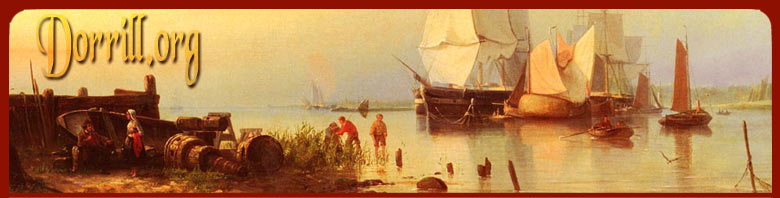
Thomas Dorrell: by James S. Dorrill [Prepared from "The Flowering of the Maryland Palatinate," by Harry Wright Newman, Baltimore: Genealogical Publishing Co., 1985.] The morning was rather cloudy and somewhat bleak, so characteristic of coastal England in the late autumn. The day was Friday, November 22nd or the Feast of St. Cecilia, according to the religious calendar to be more exact, and the year was 1633, when the Ark and her pinnace the Dove were moored restlessly in the harbor of Cowes on the Isle of Wight. The two ships had remained in the harbor now for several weeks after having sailed down from London. It was fully ten o'clock in the morning, but that small village on the northern coast of the Isle was wide awake, for Englishmen rose early for their labor in that day. The two ships were rather crowded, Thomas Dorrell surely thought, with nearly two hundred fellow passengers or Adventurers destined for that new, unseen, and untamed land in Virginia north of the Potomac River now given the name of "Merrie Land". Thomas and these two hundred or less Englishmen were leaving their ancestral homes with high hopes and expectations to establish a permanent settlement in the New World. [To the Britisher of the 17th century, Virginia was a geographic term given to that vast and undefined portion of North America which John and Sebastian Cabot discovered and claimed for the Kingdom of England. Virginia in a broad sense and the Colony of Virginia were therefore two different and separate entities.] Mr. Dorrell, styled by Lord Baltimore as one of Seventeen Gentlemen of Fashion on the voyage, was near the forward deck of the Ark surrounded by the other gentlemen Adventurers, as the heavy iron anchors were lifted from the brownish waters of the two straits known as the Solent and the Spithead, actually inlets from the English Channel which separated the Isle from the mainland. The ships then sailed slowly away from their moorings; an event that can be said to be the genesis of Maryland, another link in the coming British Empire. Within a few minutes, the two ships were passing slowing between the shore of the Isle and the mainland of Old England, some distance away but visible on a clear day. [Lord Baltimore was one of the backers of the endeavor. "Gentleman of Fashion" was a phrase relating to social status, a member of the gentry, generally indicating wealth and land ownership.] Thomas survived the hardship of the voyage, but all were not so lucky. The rigors of that transatlantic passage began to claim the first casualties of the Adventurers, for at times there certainly must have been bad drinking water and although the food was well salted, it often spoiled during the latter part of the voyage. At least twelve were reported to have died before reaching the mainland Maryland. Reading contemporary narratives of that period reveal conditions almost unbelievable. One seaman writing of his trip to America stated that the bread was so full of midgets [? maggots] that if you left it on the board [table] it would walk. Conditions on some of the ships carrying colonist to Virginia were likewise deplorable. One wife who crossed the ocean with her husband in 1622, wrote to her sister in England that the vessel was so infected that she "saw little but throwing folke overboard...few els left alive that came in that shipp." After landing, and as the first summer in Maryland approached, mortality must have been extremely high. The malaria mosquito to which they had not been accustomed in England, inflicted fever which they called "ague" after an ailment characteristic of that day in England. A Dutchman in Virginia during 1630 remarked that unseasoned people in Virginia died like cats and dogs between June and August. Perhaps the greatest disease or pestilence other that ague or malaria sustained by the colonist was dysentery. Bleeding was resorted to in all cases of high fever, but instead of aiding the patient, as we now know, it only aggravated the condition. Contaminated drinking water, even after the sea voyage, continued to be the cause of certain diseases, and the excessive consumption of beer and wine during illnesses certainly did little to help the patient. These conditions along with the unaccustomed changes in climate, the hardships of colonizing raw, untamed land, lack of knowledge of sanitation, improper diet, decomposed food, and unintelligent methods of healing, continued to take a toll of the settlers—including Thomas. Thomas Dorrell, one of the Gentlemen of Fashion who came to "Merrie Land" in 1633, died early in the settlement before 1638, possibly within months after disembarking. There is no record of his claiming land or making any assignments to a third party. The Secretary of the colony wrote to Lord Baltimore, "Spoke with Mr. Copley about Mr. Dorrell's goods...but no will of Mr. Dorrell yet proved, no administration taken out, no inventory of the goods, some remaining in my hands." No further references to Thomas or his estate have been found. He probably left no issue in Maryland, or are his heirs known. |